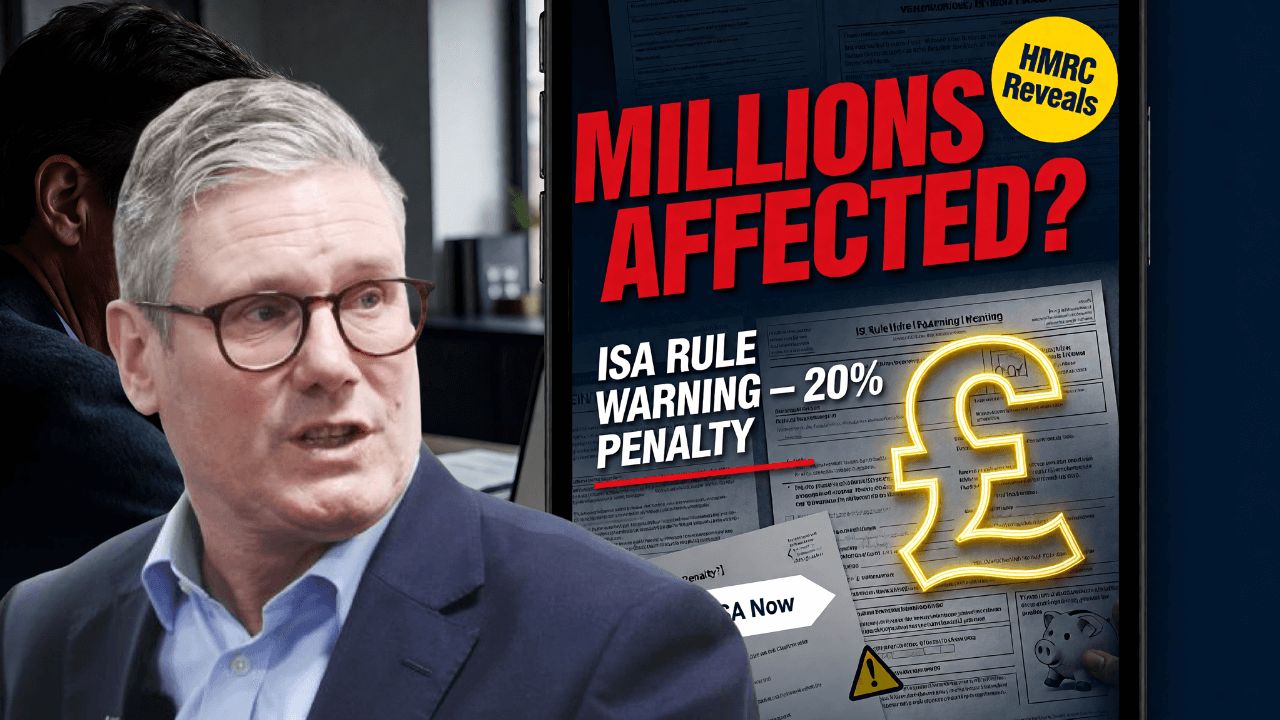
Millions of UK savers rely on Cash ISAs as a safe and tax‑efficient way to grow their money. For years, these accounts have been marketed as straightforward: deposit within your annual allowance, earn interest tax‑free and withdraw when needed.
However, recent clarification from HM Revenue and Customs has highlighted a compliance issue that could leave some account holders exposed to a 20% tax charge if rules are misunderstood or breached.
Headlines referring to a “loophole” and a “20% penalty” have understandably caused concern. But what does this really mean? Is HMRC introducing a new fine? Are ordinary savers at risk of losing part of their savings?
Here is a clear and practical explanation of the situation, who may be affected and how to avoid problems.
What Is a Cash ISA
A Cash ISA is an Individual Savings Account that allows you to earn interest without paying income tax on the returns.
Each tax year, UK residents can deposit up to the annual ISA allowance across eligible ISA products. The allowance applies collectively across:
Cash ISAs
Stocks and Shares ISAs
Innovative Finance ISAs
Lifetime ISAs
Interest earned inside the ISA is tax‑free, and withdrawals do not usually incur tax.
Where the “Loophole” Comes From
The issue does not relate to normal saving behaviour. Instead, it concerns specific circumstances where ISA rules are breached, intentionally or unintentionally.
Examples include:
Subscribing more than the annual allowance
Opening multiple Cash ISAs in the same tax year without proper transfer procedures
Replacing withdrawn funds incorrectly
Incorrectly claiming eligibility when non‑resident
If rules are broken, HMRC can void the tax‑free status of part or all of the ISA.
When this happens, interest earned may become subject to income tax — typically at 20% for basic rate taxpayers.
That is where the “20% penalty” headline originates.
It Is Not a New Tax
There is no brand‑new 20% fine being imposed on all ISA holders.
The 20% figure simply reflects the standard basic rate of income tax that applies if ISA tax protection is removed.
If an account loses its ISA status due to non‑compliance, the tax‑free shield no longer applies.
The key point is that compliant savers face no change.
Common Mistakes That Trigger Problems
Many breaches happen accidentally.
For example, if someone:
Opens two Cash ISAs in the same tax year and contributes to both without formally transferring funds
Exceeds the annual allowance due to miscalculation
Replaces withdrawn funds in a flexible ISA incorrectly
Transfers money themselves instead of using the official ISA transfer process
Even small errors can trigger HMRC review.
The Annual Allowance Rule
Every tax year, there is a maximum amount you can contribute to ISAs.
If you deposit more than the allowed amount, the excess may not qualify for tax‑free treatment.
HMRC may instruct the provider to remove the excess or reclassify earnings.
In some cases, interest earned on the excess amount becomes taxable.
Flexible ISA Confusion
Flexible ISAs allow you to withdraw and replace money within the same tax year without reducing your allowance.
However, not all ISAs are flexible.
Some savers assume they can withdraw and redeposit freely across different providers. That is not always permitted.
If replacement rules are misunderstood, contributions could exceed the allowance inadvertently.
Transfers Between Providers
To retain tax‑free status, transfers must be completed through an official ISA transfer process.
Withdrawing funds and manually redepositing them into a new ISA counts as a new subscription.
If this pushes total contributions above the annual limit, the excess becomes problematic.
Using the correct transfer form prevents this issue.
Residency Rules
Only UK residents are eligible to subscribe to an ISA.
If someone becomes non‑resident and continues contributing, those subscriptions may be invalid.
Existing funds can remain, but new contributions while ineligible could result in tax consequences.
What Happens If HMRC Finds a Breach
HMRC typically contacts the ISA provider first.
In many cases:
Excess contributions are removed.
Interest on invalid amounts becomes taxable.
The ISA may be partially or fully voided.
For basic rate taxpayers, this can mean 20% tax applied to the interest that should not have been sheltered.
It is not usually an automatic punitive fine — it is a correction of tax treatment.
How Likely Is This to Affect Millions
While headlines suggest “millions,” the majority of ISA holders follow rules correctly.
The risk applies mainly to:
Frequent ISA switchers
High savers contributing close to the limit
Individuals misunderstanding flexible rules
People with multiple accounts across providers
Most ordinary savers depositing within limits into a single ISA are unaffected.
What About Savings Interest Outside an ISA
If ISA protection is lost for certain funds, interest may be taxed under normal income tax rules.
Many savers also benefit from the Personal Savings Allowance, which allows basic rate taxpayers to earn up to £1,000 in interest tax‑free outside ISAs.
This means even if some ISA interest becomes taxable, it may still fall within savings allowances.
Why HMRC Is Highlighting This Now
ISA participation remains high, and digital banking has made switching easier.
With multiple providers and instant transfers, unintentional breaches are more likely if savers do not track totals carefully.
HMRC’s clarification appears designed to:
Improve awareness
Prevent widespread small breaches
Reduce administrative corrections later
The aim is compliance, not punishment.
What You Should Check Immediately
If you hold one or more Cash ISAs:
Confirm your total contributions this tax year.
Check whether all accounts are flexible or not.
Ensure transfers were done via official provider processes.
Review residency status if applicable.
If unsure, contact your provider for clarification.
What To Do If You Made a Mistake
If you suspect you have exceeded the allowance:
Do not attempt to fix it yourself by withdrawing funds.
Contact your ISA provider.
Wait for official instruction from HMRC if necessary.
In many cases, providers can correct errors before serious consequences arise.
Does This Affect Lifetime ISAs
Lifetime ISAs have separate penalty structures, including withdrawal charges.
The 20% figure discussed in relation to Cash ISAs does not represent a new Lifetime ISA penalty.
Different rules apply.
Is Your Money at Risk
Your capital is not automatically confiscated.
If tax becomes payable, it applies to interest earned on non‑compliant amounts, not the full balance.
For example, if £500 in excess contributions earned £20 in interest, tax would apply to the £20 — not the £500 principal.
Understanding this distinction reduces unnecessary alarm.
Frequently Asked Questions
Is HMRC introducing a new 20% ISA fine
No, 20% reflects the standard income tax rate applied if ISA protection is removed.
Will all ISA holders be penalised
No, only those breaching contribution or eligibility rules.
Can HMRC take money directly from my account
Tax is collected through normal processes, not sudden withdrawals.
Do I need to close my ISA
No, compliant accounts remain unaffected.
Key Points to Remember
There is no blanket new ISA penalty.
The 20% figure relates to standard tax rates.
Most savers are unaffected if within rules.
Transfers must follow official processes.
Always monitor total annual contributions.
Final Thoughts
Cash ISAs remain one of the simplest and most tax‑efficient savings vehicles available in the UK. The recent clarification from HMRC does not change their core benefits. Instead, it reinforces the importance of understanding contribution limits and proper transfer procedures.
For the vast majority of savers, nothing changes. As long as you stay within the annual allowance and follow official processes, your tax‑free status remains intact.
If headlines about a “20% penalty” caused concern, the key takeaway is simple: this is about correcting mistakes, not imposing new widespread fines.
Stay informed, keep accurate records and review your contributions annually. With those steps, your Cash ISA remains a secure and efficient way to grow your savings tax‑free.